
Irony
The irony of teaching school does not escape me. While I loved learning, I truly hated school. I loved the idea of school but hated the reality. In my public-school career, I only had two teachers even bother to talk to me in a positive way. The majority of my adult interactions were always disparaging, condescending, and outright mean spirited. Adults in the school system were not to be trusted. No one had a kind word, and not one single teacher ever took me to the side and asked me if I was okay. Not one. Furthermore, when I was in school, dyslexia was not even a name. All I knew was that I learned differently from others, that I had to hear the instructions. Even to this day, I can eerily recall conversations word-for-word. (It drives my family crazy.) I remember my grandmother teaching me to read, and I realized that I memorized words because of the shape I saw connected to the pronunciation. It’s a bit weird to explain. But even now, if I see the word misspelled, I am doomed. I literally have to close my eyes, say the word, and see the image if I stumble on the spelling. My students laugh at me, because when I type something, I never look at the monitor or the keyboard. If I look, I will more than likely misspell something. Again, it’s difficult to explain, and we won’t even talk about algebra. We didn’t have a TV growing up, and fortunately for me, that was a boon; because, the only entertainment to be had was either music or reading. So, I enmeshed myself and became an avid reader and music lover.
My mother had died, and I had been out of high school for 10 years before I went to college. I always wanted to go to college, but the one and only time I had ever talked to a high school counselor she said, “People like you don’t go to college.”
I had no idea how poor people got to college, so instead I just went to work. I was fortunate in my job choices, and eventually went to college and kept climbing the corporate ladder. However, in the end, it wasn’t who I needed to be. My uncle (a war veteran and teacher) laughed at me when I told him I wanted to teach. I’ve regretted the hit to my pocket book. I’ve regretted the lack of respect and voice teachers have. I have never, not once regretted serving students. Not once.
The one most important aspect to teaching is connecting with your students. I have had an extraordinary life, and that life has allowed me to reach some of the most reluctant students. It has allowed me to set aside judgement and take students for who they are—human beings who want what we all want—love, acceptance, understanding, and safety. And that is what I offer them.
However, I am also an extremely private person and letting people (adults) into my inner thoughts is not my strong point. But my goal with this blog is to do just that. I will offer you the same I offer all my students: no judgement, just acceptance—and I would ask the same of you.
I love discussion. I truly believe that conflict is the only thing that moves us forward. Therefore, while I encourage differences of opinions, remember, it’s not what you say, but how you say it. Be kind in your disagreements. Be firm but be kind.
I have always started my school years with a symbolism project. So, in this blog, I am opening to the public the stories I have shared with my students. The “why” I am a teacher. The “why” of my three most powerful symbols, and the “why” it is important.
As teachers, parents, and regular citizens, the way we treat our youth determines all our futures.

Butterflies, Sunflowers and Dragons: The three defining moments.
Butterflies
We all have defining moments in our lives. It’s much like a timeline, those important moments that shape or decide which path you travel. The road signs in your journey that remain forever locked in your memory. My memoires of school were never great, but my fourth-grade year was a life-awakening time. It was a shift of reality and a true reckoning of what had transpired before this time, and the realization that things would never be the same. You can never un-ring a bell.
My life leading up to the summer before fourth grade had always been turbulent, but for me I thought everyone’s life was like that. My mantra, You only know what you know, rings true for us all. Normal is only what you are used to. And for me, my life was normal. But the summer before fourth grade and a few weeks before school started, my dad bought a small dirt farm and moved us out into the middle of a cotton field. I kid you not. I came home from visiting my grandparents to a new house (if you could call it that). My dad bought a “well-used” single wide trailer house, had a well and septic tank put in and poof, we were farmers.
The trailer house was tiny and old, had a hole in the floor in front of my brother’s room we covered with a piece of plywood, no air-conditioning, and when (or if) it rained, water poured down the hallway wall like a waterfall. We put up a sheet metal barn, built a chicken coop out of scrap wood, got a calf at the feed lot for $7 dollars, and three chickens for $5. My dad bought a 1940’s tractor for $200. We were in business.
The bus ride to school was an hour. New school, no friends, living way out in the country. Things were definitely different, and as the shy girl, who talked funny I was scared. My school was not a good school. Later it was rumored that if you couldn’t find a job teaching in the state of Texas, this school district would hire you. The only people with money were the big-time farmers. Everyone else were dirt farmers and hard labor workers. Us hard labor workers were the majority. White people were the minority.
Because of our situation, my clothes came from the church closet. And at the beginning of fourth grade, I was so ecstatic, because for the first time, I had a pair of pants! They were brown, brushed-Demin and so soft. Because they were used, and because I was a tom-boy at heart, the first week I had worn a hole in the knee. However, my mom cut out a red butterfly patch and ironed it over the hole. I was thrilled, because now my pants had a new design. I was so proud of those pants. I wore them all the time. To be honest, I didn’t have a lot of clothes, so I had to wear them all the time, but I truly thought nothing of it because I loved those pants so much.
In class, the teacher was handing out forms for the Free Lunch program. When the kids in class asked what it meant, my teacher did not mince words. She literally said, “If you are poor and your parents can’t afford to feed you, then they fill out this form so you can have free lunch.”
One student asked, “How do you know if you’re poor?”
And the teacher replied, “If you have patches on your pants like Lucinda, then you’re poor.”
I actually remember that day so clear. It was a defining moment. Suddenly, the shy and bashful girl was the center of attention—and that attention was not fun. I sat there, tears streaming down my face, stroking my beautiful patch as the students were pointing and making fun of me, calling me all sorts of names, like patches, dirty white trash, and poor poor pants are brown. The teacher did nothing to stop it. It was also the second to last time (the last being in eighth grade) that I ever cried openly in front of people.
I went home devastated. Yes, it was true we didn’t always eat well, but I was clean, I didn’t smell, and I was a nice person. My grandmother always said, “Cleanliness was next to godliness.” When I asked my mother, she confirmed that “Yes, we are what some would call poor.” Other than that, she went about her business.
Several things changed for me that year. My mom did fill out the paper for free lunch, but we were denied because the office said, “Free lunch wasn’t for white people.” (True fact—different times). She didn’t argue. Neither one of my parents had graduated high school, so they just took the word of the current person in power. So, there were plenty of days I didn’t eat lunch at school. I became strong as steel. I hated that teacher. I would just glare at her all day. I hated the students who not only got free lunch, but still made fun of me. And I hated people I thought were rich—because they always made fun of me. I made one friend, and that was the only person I talked to. And if a peer invaded my space, I was fierce in my rebuttal. You could yell across the room all day at me, and I would ignore you. Dare to step into my personal space, and you were meet with the full force of my hate. I was no longer nice.
Butterflies. The reminder that no matter what your life starts out with, how ugly it may seem, there is beauty. And that beauty is about transformation (even revolution) of your life’s journey. For me, I needed to learn that there was a power structure in the world, and I needed to learn how to stand up to that power and say, “NO!” I developed a spine of steel, preparing me for what was to come.
I hated school.

Sunflowers
I hated school. Okay, I had maybe a love/hate relationship with school. During the summer I yearned for school. From sunup to sundown I was in the fields. My parents had acreage, but not enough to make a living from. So, my dad would plant an acre garden, and we would then let the “big man” plant the rest. And my job was Monday through Friday, hoeing weeds. Yes, I hoed cotton and wheat. All. Summer. Long. Cotton is vicious. Wheat, when it grows tall, allows you to lay in the rows with a light breeze, the shade of the leaves, and enjoy a quiet lunch. Cotton is vicious. I hated cotton. My summer consisted of weeds, sun, abuse, calluses, and endless work. If I wasn’t in the big man’s fields, I was in our garden doing the same thing. Early in the morning, I would sneak food, pack a lunch in a tin lunch box and bury it in the field to keep it cool. My mom stayed in the house all day (doing what I never could glean) and would go collect my weekly cash. I never saw a dime.
I longed for school, because the summers were miserable. I liked learning. I hated school. On Saturdays, my grandmother would come collect me and take me to town—to her house, because I was her “cleaning lady.” I loved Saturdays. I loved cleaning her house. She had air-conditioning. Saturday night I would get to soak in her fancy tub (I thought it was fancy, but I now know it was just a regular tub) eat a wonderful dinner, and we would secretly dance to the Lawrence Welk Show. We didn’t have a TV at my house, so I didn’t mind watching anything my grandmother wanted to watch. My grandmother is the only reason I am alive today. She saved my life. (Different story.) We would go to church on Sunday, everyone would come over for Sunday lunch, then my mom would take me back home.
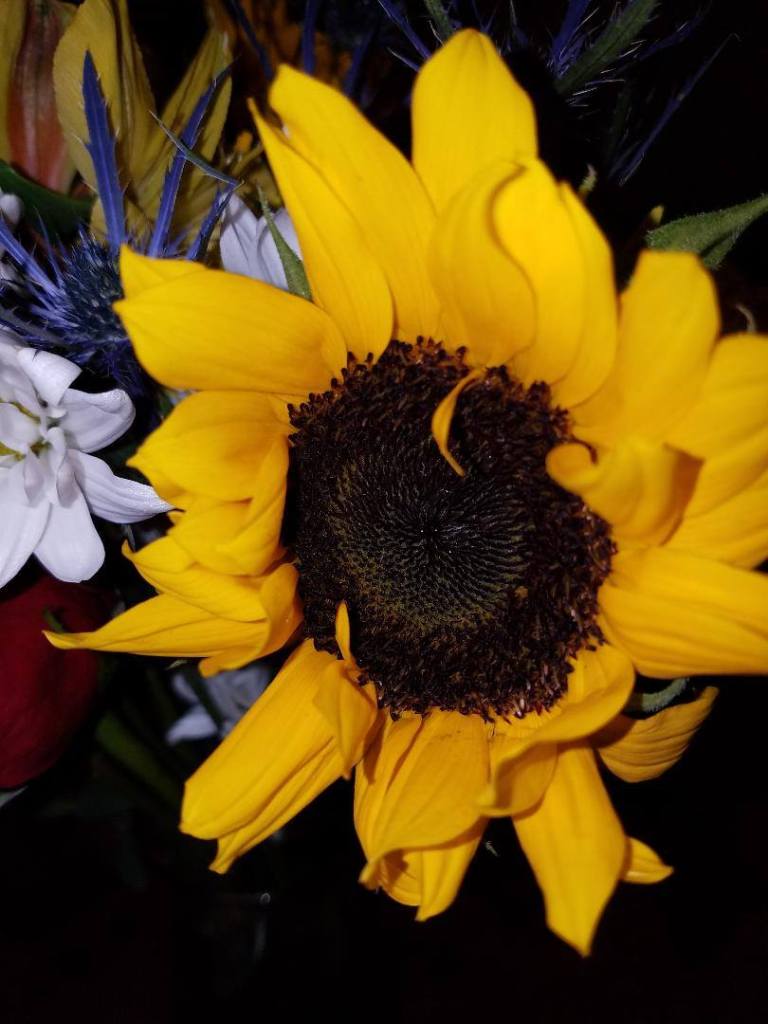
Early in the spring, my grandmother gave me a packet of sunflower seeds. She told me that everyone should have brightness and flowers in their lives. Also, sunflowers were practical because the seeds were food. I looked sunflowers up in the encyclopedia and was fascinated. Not only are sunflowers tall (which I wasn’t) but they were strong! And they tracked the sun. The looked towards the light, and when matured, they generally faced the east, always looking for the sunrise. The symbolism resonated with me. I planted and nurtured those seeds, and low and behold I had my own small patch of sunflowers. My mom would just laugh at me as I visited my patch in the mornings and stayed with them when the sun went down. I loved those flowers. They were huge!
But there is always a dark side—especially when school started. At the beginning of my eighth-grade year, my mom bought some material at Goodwill to make me a new outfit. The material was hideous. Keep in mind, disco era. Bright blue polyester, with lime green stalks and leaves traveling up the pattern, with neon yellow sunflowers at the bottom of the pattern. They were curtains! My mom made a pants suit out of my favorite flowers. Imagine, huge billowing extra-gathered bell-bottom sunflowers with stalks and leaves traveling up your skinny body. It was a disaster.
I gazed in horror! I was NOT wearing that to school. No way. No way. No way.
Way. My mom (although we didn’t know it at the time) was not well mentally. You have to understand, in those times, no one knew what dyslexia was, nor did anyone ever talk about depression, or mental illness. You only know what you know, and what I knew was that my mom was unpredictable and scary. And my mom was adamant.
My mom got up before me Monday morning. My mom had not gotten up and helped me get ready for school since third grade. My mom’s morning presence did not bode well for me. In fact, it was a nightmare. I refused to wear the new “suit” and my mom, who was six inches taller and outweighed me by at least 140 pounds, physically fought me and dressed me in that suit. The screams, bruises and tears clashed with the neon colors. The scene was straight from some after-school special. In the end, I lost that battle and was dragged by my arm to the bus stop, screaming and kicking all the way. My brother refused to even stand next to me. My mom shoved me onto the bus and marched back to the house.
The bus driver openly laughed at me. The students on the bus fell over they were laughing so hard at me. I looked like I had stepped off the neon sunflower clown ride. I cried all the way to school. Teachers in the hallway would point and laugh at me. Classes were miserable and I cried all day. I hid in the bathroom at lunch. The only consolation was my best friend, who would quietly hold my hand as I cried. The bus driver again laughed at me on my way home and as I exited the bus, said, “See ya tomorrow, Sunshine.”
I walked into the house never stopping, dropped my books, went through the kitchen, scooped up some matches, and never missing a step marched out the back door straight to the trash bin. I stripped that suit off my body, threw it in the barrel, lit a match and stood in my undies watching that polyester suit burn!
This was way before fire-retardant material, and “whoosh”! The flames were magnificent. My mom came running out of the house, and I received my second physical beating for the day. Right there in the yard, nearly naked. And.It.Was.Worth.It.
No breakfast, no lunch, no dinner. I cried myself to sleep in my sunflower patch, stroking their fuzzy stems. I never cried in public again.
Sunflowers: They look towards the new day. They provide nourishment. Sunflowers remind me that I can survive even the harshest of times, because the true guarantee is that tomorrow is a new day.
I hated school.
Dragons
My sophomore year was to be the best year of my life—or so I thought. Growing up where I did, violence was an everyday occurrence. At school and at home. My school was tough, and times were different. There were no gun laws, or knife laws, and nearly every kid in school carried some sort of weapon. And you had to belong to a group—outsiders were not protected or safe. Woe to any new students. I had been going to the same school since fourth grade. We all rode the busses together, kindergarten through seniors. The elementary school was across the street from the junior high and high school. The junior and high school were in the same building, separated by the gym. All you had to do to get to one school or another was walk through the gym.
Growing up as I did, I was not fond of people touching me. Usually, touching meant hurting. As a female, it was common for boys to snap your bra strap as you walked by, say something about your body, or put their hands on you. Girls hated it, but somehow the culture supported this behavior. My freshmen year was an unmitigated disaster. My brother was a senior and in trouble all the time, and we did not belong to the same “group” of friends. Unusual maybe, but our school’s gangs were not all about race, but rather who we connected with. I mean, most students were Latino, so race was only an issue if you were dumb, but who your “friends” were, was the biggest issue. My friends and I shared the summer rows of hoeing and heat.
Anyway, teachers openly hated my brother. My math teacher, on the first day, asked if I was my brother’s little sister. I quietly said “Yes, sir.” He replied, “You will fail my class.” Then it was his personal mission to fail me—no matter what. I was fortunate enough to belong to a group of large Latino “friends,” but unfortunately my brother belonged to his own group of friends, and those groups hated each other. I was stalked one week by a senior girl, who screamed at me all week long. Then on Friday, she jumped me as I was coming out of my “favorite” math class. I was not in the mood. She laid hands upon me. I hit her once in the face, she fell, I stepped on her throat and promised harsh retribution if she laid hands on me again. The fight was over. Except it was one of my brother’s gang girls. My brother’s best friend hit me one day in retaliation, and he was so strong I flew across the hall and slammed into a locker. My friends took offense, and so the story goes, on and on. At the end of my freshman year, a new boy came to school. On his first day of school, a group of boys jumped him and cut his face with a binder. He left in an ambulance, unconscious as his head had been slammed into a concrete block.
I told my dad that I was dropping out of school. I was not going back. Keep in mind, neither one of my parents graduated high school, and my brother only graduated because I did his homework. Even though I was undiagnosed as dyslexic, I worked double-time and managed my own coping skills. I was fairly decent in school and my dad was devastated. He insisted I not drop out. Other things happened at home that didn’t involve me, and the next thing you knew, my dad came home and said he got a job driving a truck in Abilene, TX. We were not only moving, but we were moving to a TOWN!
For me, Abilene was big time! I went to my first day of band camp and the band had over 200 more people than my previous high school band. Definitely big time! I was thrilled. A new start. The school was huge with thousands of kids. No one knew who I was, no one knew who my brother was, and I was no longer white trash. I lived in a real house. The first week of school, one of the popular band boys noticed me. Me, the shy girl, who knew no one, was just asked out to the fair by a popular boy. It was my first date. I was turning 16 in a few weeks, and I was so excited. I went to the fair with him, but it was awkward, and other boys kept coming up to us and laughing and saying weird things. I had no clue. I did not come from a school where people were not upfront to your face, so I was naïve in the more sophisticated undertones of politeness with underlying menace. Where I came from, you knew if people didn’t like you. Nothing subtle about it.
The boy took me to a country road, pulled over and proceeded to kiss me. Again, my first date and I was excited that someone was kissing me—until I wasn’t. He then held me down and gave me multiple hickeys all on the front of my neck. I got a bit physical with him (which he wasn’t expecting—but hey, he didn’t know where I came from) and he conceded, as he would be walking funny the next day, and then took me home.
Unknowingly to me, it had been a dare. The popular boys dared him to take me out and “mark” me. He then went to school, told everyone I was a slut, his popular girlfriend (which I didn’t know he had) tagged me as an undesirable, and the hickeys proved the point. And just like that, the new chance I had dreamed of was shattered on a rich kid’s bet. The popular rich kids had deemed me unworthy. Even the teachers labeled me.
And a dragon was born. I held my head high, breathed fire in all their faces, denied them my tears. My scales grew thick and hard, in order to protect my heart, and I developed a fierce loathing for rich kids who had everything given to them and could only pick on the underprivileged for fun. If they even came close to me, I breathed fire.
Dragons are intensely loyal, and fierce if they perceive someone to be a threat. Dragons are not nice, and neither was I.
I hated school.

For me…
Butterflies are the proof that in order to grow, we must always change. That change, while scary, is needed. And the world needs change. Sunflowers are the reassurance that every day is a new day, and if we look to the dawn, the rising sun will feed and nourish our hopes for the future. Dragons, the misunderstood mystical creatures who are rather sensitive and lonely with hard shells to protect their heart and take the severe wounds life gives. Yet, they are also guardians and fierce in the defense of their tribe. For me, being a teacher is the quest for change, and the encouragement that no matter what, tomorrow is a new day, and the resilience to stand strong with expectations and boundaries, while giving the protection and encouragement to be free to explore not only the educational path, but the quest towards a better humanity.
For me, it’s about being the teacher and mother I never had. It’s about seeing students as who they are; about meeting students where they are; it’s about unconditional acceptance and the encouragement to explore their own beliefs; it’s about exposing students to opportunities they never knew were there; it’s about exploring all cultures and experiencing each other’s normal; it’s about creating a safe environment where students are free to say what they believe and listen to other perspectives; it’s about being the role model, holding expectations high and boundaries firm, because if we do that, we create a circle of wonderment, where within students can be safe to develop their own self-worth, and leave the classroom knowing that their today does not determine their tomorrow. Teaching is about nourishing the best of our humanity. It’s about kids.
 Lucinda Handshoe